Myofunctional Therapy: How Retraining Your Tongue Can Change Your Breathing, Sleep and Jaw
Your tongue is a muscle, and where it rests all day matters. When it sits low in the mouth instead of against the palate, it can affect how you breathe, how your jaw works, how well you sleep, and even how a child's face grows. Orofacial myofunctional therapy is a set of exercises that retrains those muscles. Here is what it does and who it helps.
What Is Orofacial Myofunctional Therapy?
Orofacial myofunctional therapy (OMT) is a structured program of exercises for the tongue, lips, cheeks and the muscles you use to chew and swallow. The goal is to build four healthy habits that become automatic:
- Lips closed at rest, so you breathe through your nose.
- Tongue resting against the palate, not on the floor of the mouth or pushing against the teeth.
- A correct swallow, with the tongue moving up and back instead of thrusting forward.
- Relaxed facial muscles, without straining the chin or clenching the jaw.
Think of it as physical therapy for the mouth. It doesn't replace dental treatment. It often makes dental treatment last longer.
Signs You May Benefit
| In adults | In children |
|---|---|
| Mouth breathing or waking up with a dry mouth | Mouth open at rest, or mouth breathing during sleep |
| Snoring or diagnosed sleep apnea | Snoring, restless sleep, bedwetting past the expected age |
| Jaw pain, clenching, or a clicking TMJ | Thumb-sucking or extended pacifier use |
| A tongue with scalloped (wavy) edges | Tongue thrust or a lisp |
| Orthodontic relapse, where teeth drift after braces | Crowded teeth or a narrow upper arch |
| Forward head posture and neck tension | Picky eating, or difficulty chewing and swallowing |
If your child shows several of these signs, see The Importance of Airway Health During Childhood Development.
What Does the Research Say?
The strongest evidence links OMT to sleep-disordered breathing. A 2015 meta-analysis in the journal Sleep (Camacho et al.) pooled studies of myofunctional therapy for obstructive sleep apnea. It found the apnea-hypopnea index fell by about half in adults and by about 60% in children, along with less snoring and less daytime sleepiness. The studies were small, so OMT is best used as part of a plan, not as a stand-alone cure for moderate or severe sleep apnea.
Evidence for other uses, such as preventing orthodontic relapse, supporting TMJ treatment, and recovery after a tongue-tie release, comes mostly from clinical experience and smaller studies. We tell patients that honestly.
What a Program Looks Like
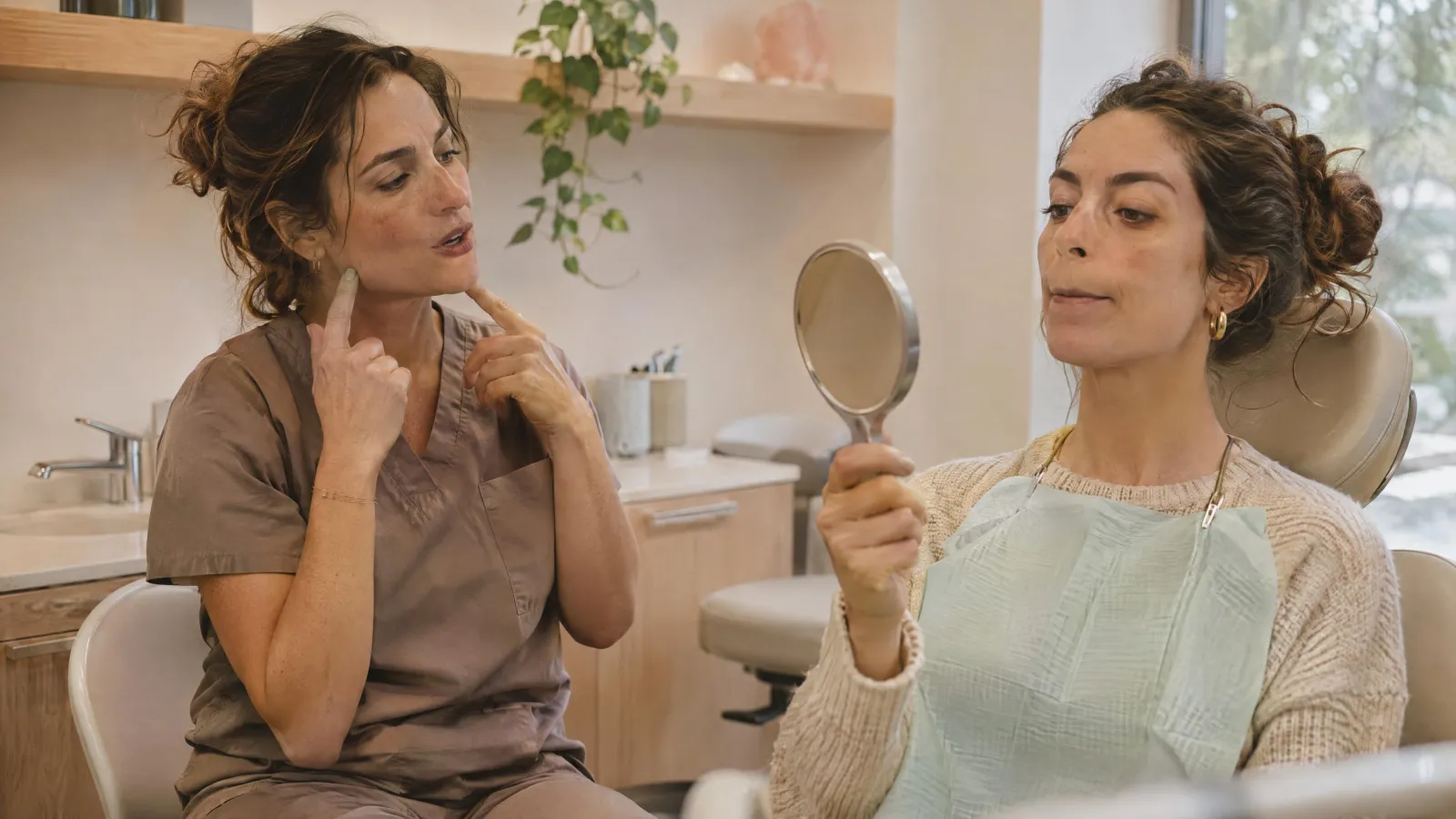
- Evaluation. We assess tongue mobility, resting posture, lip seal, swallowing pattern, nasal breathing, bite and jaw joints. We also take a sleep and symptom history.
- Daily exercises. Short routines of about 10–15 minutes a day, done at home. We progress them in stages: building awareness, then strength, then automatic habit.
- Regular check-ins. Visits every 1–2 weeks at first, then spaced out as habits form. Most programs run several months.
- Coordination. When it's needed, OMT works alongside oral appliance therapy, orthodontics, ENT care for nasal obstruction, or a frenectomy.
Success depends on consistency. The exercises are simple, but the habits you're replacing took years to form.
How It Fits Aura's Root-Cause Approach
At Aura, our goal is to help you keep your natural teeth for life by understanding why problems happen. Many of the issues we treat, such as worn teeth from grinding, jaw pain, a failing restoration or teeth shifting after braces, trace back to how the tongue, lips and airway function every day. Treating the muscles behind those problems makes every other treatment more stable. Learn more about our myofunctional therapy and TMJ, airway and sleep apnea care.
Frequently Asked Questions
Is myofunctional therapy only for kids?
No. Children often respond faster because they're still growing, but adults benefit too, especially those with mouth breathing, snoring, sleep apnea, TMJ symptoms or orthodontic relapse.
Can myofunctional therapy cure sleep apnea?
It can meaningfully reduce sleep apnea severity for some people, but it's usually one part of a plan. That plan may also include an oral appliance or CPAP, along with your physician's oversight.
Does it hurt?
No. The exercises are gentle. Some people feel muscle fatigue at first, like the start of any new exercise routine.
How long until I notice a difference?
Many patients notice easier nasal breathing and better awareness of their tongue posture within a few weeks. Lasting habit change usually takes a few months of consistent practice.
Do I need a tongue-tie release?
Not always. Your evaluation will show whether restricted tongue movement is limiting your progress. If it is, we'll discuss a release combined with therapy before and after.
Wondering If Your Tongue Posture Is Part of the Problem?
Schedule a myofunctional and airway evaluation at Aura Dental and Wellness in West Palm Beach.
Call us at (561) 299-5852 or tap "Request Appointment" on our homepage to book.
Aura Dental & Wellness · 303 Banyan Blvd, Suite 203, West Palm Beach, FL 33401 · info@auradentalwellness.com
Source: Camacho M, et al. Myofunctional Therapy to Treat Obstructive Sleep Apnea: A Systematic Review and Meta-analysis. Sleep, 2015;38(5):669–675. This article is educational and does not replace an individual evaluation.